

Clash Detection Services
BIM Coordination • Clash Resolution • Constructability Assurance. Identify and resolve conflicts between architectural, structural, and MEP systems before construction begins.
BIM Coordination & Model Validation
Clash detection is a critical component of Building Information Modelling (BIM) that ensures all architectural, structural, and MEP systems are spatially coordinated before construction.
By identifying and resolving conflicts at the design stage, projects reduce costly rework, eliminate site clashes, and improve overall construction efficiency.
Our clash detection services deliver coordinated, conflict-free BIM models aligned with international standards and project-specific BIM Execution Plans (BEP).
WHAT WE DO
We perform multi-disciplinary BIM coordination and clash detection using federated models from architecture, structure, and MEP disciplines. Using industry-leading tools, we detect hard clashes, soft clashes, and workflow conflicts, ensuring that all building systems integrate seamlessly within the available project space.
Our services support:
- Pre-construction coordination
- Design validation and optimization
- MEP routing and system integration
- Retrofit and brownfield projects
- Digital construction planning and sequencing
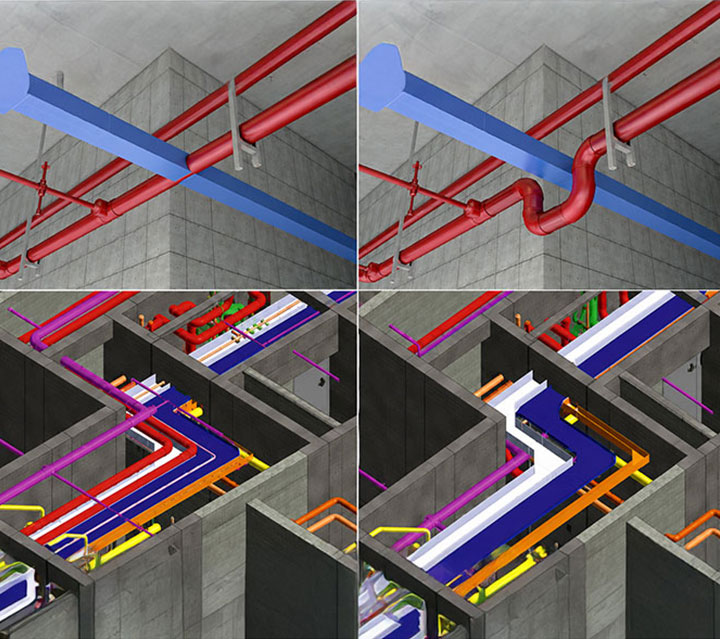
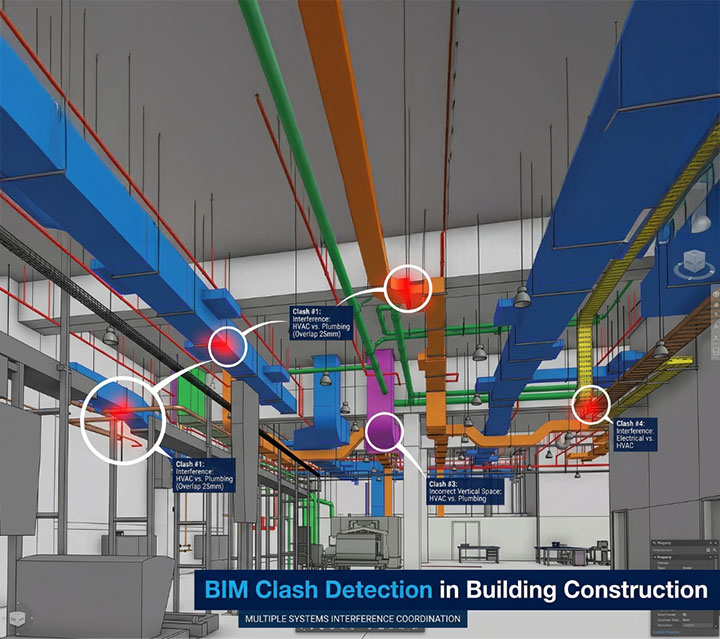
Types of Clashes We Detect
01
Hard Clashes
Direct physical interference between elements
Example: HVAC duct intersecting a structural beam
02
Soft Clashes
Violation of required clearance or maintenance space
Example: Insufficient access around equipment
03
Workflow / 4D Clashes
Conflicts in construction sequencing or scheduling
Example: Two trades scheduled simultaneously in same space
Clash Detection Approach
Basic Clash Checking
- Model aggregation without deep data validation
- Clash detection focused on major geometry conflicts
- Fast turnaround for early-stage coordination
- Suitable for concept design and preliminary reviews
Advanced BIM Coordination
- Fully federated BIM model (Arch + Struct + MEP)
- Rule-based clash detection using defined tolerances
- Issue tracking using BCF (BIM Collaboration Format)
- Iterative coordination cycles until clash-free status
- Integration with BEP, EIR, and ISO 19650 workflows
Level of Coordination (LOC)
From early spatial checks to fabrication-ready coordination — clash detection scoped to the level your project needs.
Concept Coordination
Basic spatial alignment, minimal clash checks
Preliminary Coordination
Major systems aligned, initial clash detection
Detailed Coordination
Precise geometry, discipline coordination
Construction Coordination
Full system integration with clearance checks
Fabrication Coordination
Clash-free model ready for fabrication and installation
Clash Detection Services Workflow
01
1. Model Collection & Validation
- Receive discipline models (RVT, IFC, NWC)
- Verify model alignment, coordinates, and naming conventions
- Ensure compliance with BIM standards and BEP
02
2. Model Federation
- Combine architectural, structural, and MEP models
- Create a unified coordination model
- Align shared coordinates and levels
03
3. Clash Rule Setup
- Define clash tests (e.g., duct vs beam, pipe vs wall)
- Apply tolerance thresholds and clearance rules
- Categorize clashes by priority and discipline
04
4. Clash Detection Execution
- Run automated clash detection
- Identify hard, soft, and workflow clashes
- Group and classify clashes for analysis
05
5. Issue Tracking & Reporting
- Generate clash reports (HTML, PDF, BCF)
- Assign clashes to responsible teams
- Include screenshots, viewpoints, and descriptions
06
6. Coordination & Resolution
- Conduct coordination meetings with stakeholders
- Resolve clashes in native authoring tools
- Update models and re-run clash tests
07
7. Coordination & Resolution
- Conduct coordination meetings with stakeholders
- Resolve clashes in native authoring tools
- Update models and re-run clash tests
08
8. Final Validation & Delivery
- Achieve clash-free or acceptable tolerance model
- Deliver federated model with reports
- Provide coordination summary and QA documentation
Deliverables
Benefits of Clash Detection
- Reduces construction rework and cost overruns
- Improves design accuracy and coordination
- Enhances project timelines and delivery speed
- Minimizes on-site conflicts and delays
- Enables better decision-making using BIM data
Use Cases
- Commercial building MEP coordination
- Industrial plant design validation
- Infrastructure and utility clash analysis
- Hospital and complex facility coordination
- Retrofit and renovation projects
Quality Control & Standards
- ISO 19650 compliant workflows
- BEP-driven coordination process
- Structured naming conventions and model validation
- Tolerance-based clash filtering
- Audit-ready documentation and reporting
Frequently Asked Questions
Clash detection identifies conflicts between structural, architectural, and MEP elements in 3D models before construction begins, reducing costly on-site issues.
Point clouds reflect real as-built conditions, allowing accurate detection of clashes that are often missed when using outdated drawings.
Renovation projects involve existing constraints, and clash detection helps avoid unexpected conflicts with hidden services and structures.
By resolving conflicts during the design stage, clash detection prevents on-site rework, material wastage, and schedule delays.
Yes, scan-based 3D models enable reliable clash detection in tight and congested plant environments where space is limited.
It ensures new systems integrate smoothly with existing assets by identifying spatial conflicts before installation.
Clash detection covers architecture, structure, HVAC, piping, electrical, and fire-fighting systems within a coordinated model.
Clash detection is performed using BIM software integrated with scan-based models and point cloud data.
Deliverables include clash reports, coordination models, issue logs, and revised models for construction readiness.
It creates a shared coordination platform, improving communication between designers, engineers, and contractors.
We support RVT, IFC, NWC/NWD, DWG, and other standard BIM formats for clash detection and coordination.
Typically 2–5 coordination cycles are required depending on project complexity and discipline involvement.
We aim for zero hard clashes and acceptable soft clashes based on project-defined tolerances.
Yes, we follow ISO 19650, BS standards, and client-specific BIM Execution Plans.
Start your Clash Detection project today.
Need an accurate Clash Detection report from Scan to BIM or CAD to BIM project?
Share your project requirements or input files.
We will review and provide a clear scope, timeline, and deliverables.
Headquarters
Rajkot Office
Nr. Shreeji Gau Shala, B/h Tulip Party Plot
Premvati, Vavdi, Rajkot – 360004
India
Vadodara Office
3rd Floor, Siddharth Magnum Plus
Tarsali – Danteshwar Ring Road
Vadodara -390009
General Inquiries
© 2026 Fibrox 3D. All rights reserved. | Developed by SkyWebTech