Introduction to 3D Scanning Technologies
3D scanning technologies have transformed the way industries capture and analyze real-world objects. From construction and manufacturing to healthcare and heritage preservation, these technologies help create highly accurate digital representations of physical objects.
In simple terms, 3D scanning technologies allow you to capture the shape, size, and geometry of an object and convert it into a digital 3D model. This eliminates manual measurements and improves both speed and accuracy.
With the growing demand for precision and efficiency, businesses are increasingly adopting different types of 3D scanning technologies to streamline workflows and improve decision-making.
What are 3D Scanning Technologies?
3D scanning technologies refer to advanced methods used to capture the physical dimensions and surface details of an object or environment. These technologies collect data in the form of point clouds or meshes, which are then used to create detailed 3D models.
Unlike traditional measurement methods, 3D scanning provides:
- High accuracy
- Faster data collection
- Detailed visualization
- Reduced human error
These technologies are widely used in industries such as engineering, architecture, automotive, aerospace, and industrial design.
Types of 3D Scanning Technologies You Should Know
Understanding the different types of 3D scanning technologies is important because each method is designed for specific use cases, accuracy levels, and environments. Choosing the right technology can save time, reduce costs, and improve project outcomes.
Below are the most widely used and practical 3D scanning technologies explained in a simple and useful way:
Laser Scanning (LiDAR)
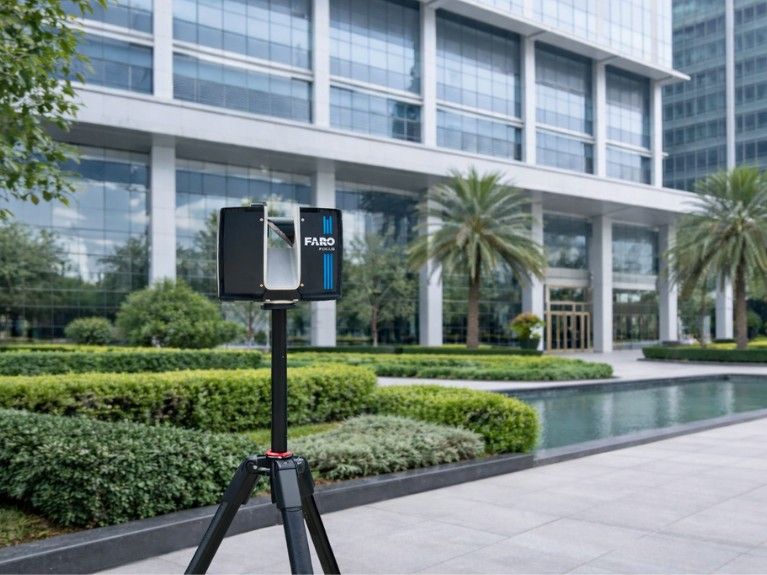
Laser scanning, also known as LiDAR (Light Detection and Ranging), is one of the most powerful and widely used 3D scanning technologies in industries today.
It works by emitting laser beams toward a surface and measuring the time it takes for the light to return. This data is used to create a highly accurate 3D representation of the environment.
Where it is used:
- Construction and infrastructure projects
- Plant and industrial facilities
- Large buildings and outdoor environments
- Railway, roads, and smart city projects
Why it’s useful:
- Captures millions of data points in seconds
- Works well even in complex environments
- Ideal for large-scale and long-range scanning
Example:
If you need to scan an entire factory or railway station, LiDAR is the best choice because of its speed and coverage.
Structured Light Scanning
Structured light scanning uses projected light patterns (usually stripes) onto an object. The way these patterns deform helps calculate the exact shape and geometry.
This method is best suited for capturing fine details with high precision.
Where it is used:
- Product design and development
- Reverse engineering of small parts
- Quality inspection and testing
- Medical and dental applications
Why it’s useful:
- Extremely high accuracy for small objects
- Fast scanning process
- Excellent surface detail capture
Example:
If you want to scan a mechanical part or a small component for reverse engineering, structured light scanning is highly effective.
Photogrammetry
Photogrammetry is one of the most accessible and cost-effective 3D scanning technologies. It works by taking multiple images of an object or area from different angles and converting them into a 3D model.
Unlike laser scanning, it relies on cameras instead of sensors.
Where it is used:
- Land surveying and mapping
- Heritage and monument documentation
- Drone-based aerial surveys
- Real estate and site visualization
Why it’s useful:
- Low equipment cost
- Easy to deploy using drones or cameras
- Ideal for large outdoor areas
Example:
If you want to create a 3D model of a large land area or historical monument, photogrammetry is a practical solution.
Time-of-Flight Scanning
Time-of-Flight (ToF) scanning measures the time taken by light to travel from the scanner to the object and back. It is commonly used in depth-sensing cameras and real-time scanning systems.
Where it is used:
- Mobile scanning devices
- Robotics and automation
- Real-time object detection
- AR/VR applications
Why it’s useful:
- Fast and real-time data capture
- Suitable for moving objects
- Compact and widely integrated into devices
Example:
Face recognition systems and mobile 3D scanning apps often use Time-of-Flight technology.
Contact 3D Scanning
Contact 3D scanning is a traditional method where a probe physically touches the object to measure its geometry. While slower than other methods, it provides extremely precise results.
Where it is used:
- High-precision engineering
- Tool and die manufacturing
- Inspection of critical components
Why it’s useful:
- Very high accuracy
- Reliable for exact measurements
- Ideal for small and complex parts
Example:
In aerospace or precision manufacturing, contact scanning is used when accuracy is more important than speed.
Watch Video:
Quick Tip: How to Choose the Right Technology
- Large projects (buildings, plants) → Use LiDAR
- Small detailed objects → Use structured light scanning
- Large outdoor areas → Use photogrammetry
- Real-time applications → Use Time-of-Flight
- Ultra-precision needs → Use contact scanning
How Do 3D Scanning Technologies Work?
The working of 3D scanning technologies typically involves three main steps:
1. Data Capture
The scanner collects data from the object using lasers, light patterns, or cameras. This creates a point cloud representing the object’s surface.
2. Data Processing
The collected data is processed to remove noise and convert it into a usable format such as a mesh.
3. 3D Model Creation
The processed data is converted into a detailed 3D model using specialized software, which can then be used for analysis, design, or manufacturing.
Benefits of Using 3D Scanning Technologies
3D scanning technologies offer numerous advantages across industries:
1. High Accuracy and Precision:
These technologies provide highly accurate measurements, reducing errors and improving project outcomes.
2. Faster Data Collection:
Compared to manual methods, 3D scanning significantly reduces the time required to capture complex geometries.
3. Improved Productivity:
Automation of measurement and modeling processes increases efficiency and saves resources.
4. Better Visualization:
3D models allow better understanding and visualization of objects, helping in planning and decision-making.
5. Cost Savings:
By reducing rework and improving accuracy, 3D scanning helps lower overall project costs.
Conclusion
3D scanning technologies have become an essential tool for modern industries. Whether it’s capturing large environments using LiDAR or creating detailed models with structured light scanning, each technology serves a unique purpose.
Understanding the different types of 3D scanning technologies helps businesses choose the right solution based on their project requirements. As technology continues to evolve, 3D scanning will play an even bigger role in digital transformation and innovation.
FAQs
1. What are 3D scanning technologies used for?
They are used to capture real-world objects and convert them into digital 3D models for design, analysis, and manufacturing.
2. Which is the best 3D scanning technology?
It depends on the application. LiDAR is best for large areas, while structured light is ideal for detailed objects.
3. Is 3D scanning accurate?
Yes, modern 3D scanning technologies offer high accuracy, often up to millimeter or even sub-millimeter levels.
4. What is the difference between LiDAR and photogrammetry?
LiDAR uses laser beams for accurate measurements, while photogrammetry uses images to create 3D models.
5. How much does 3D scanning cost?
The cost depends on project size, complexity, and technology used. Larger and more detailed scans generally cost more.