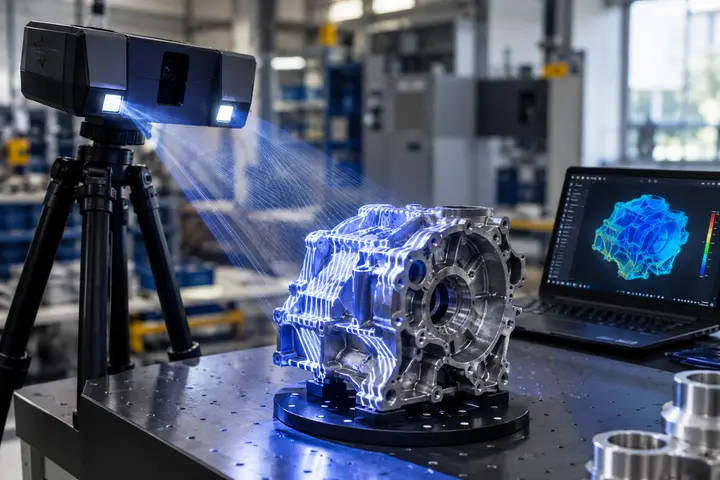
A white light 3D scanner uses structured light and cameras to capture the three-dimensional geometry of physical objects. By projecting controlled patterns onto a surface and measuring how those patterns change across the object’s shape, the scanner can collect detailed surface measurements and create a digital representation of the component.
White light 3D scanning is particularly useful for manufactured components, tooling, molds, prototypes, and other objects where detailed geometry and dimensional information are important. It can support applications such as reverse engineering, quality inspection, product development, and CAD reconstruction.
At Fibrox 3D, 3D scanning is part of a broader digital engineering workflow that can connect physical components with digital mesh and CAD models. This article explains how white light 3D scanning technology works, where it is used, its key benefits, and how it compares with laser scanning.
What Is a White Light 3D Scanner?
A white light 3D scanner is a non-contact measurement system that uses structured light to capture the geometry of an object. The scanner projects a sequence of light patterns, such as stripes or grids, onto the surface while one or more cameras record how the patterns appear on the object.
Because the surface is not flat, the projected patterns become distorted. The scanner analyses these changes to calculate the spatial position of points across the object’s surface.
The resulting measurement data can be processed into a point cloud or polygon mesh, providing a detailed digital representation of the physical component.
Unlike conventional contact measurement methods, white light 3D scanning does not require a probe to physically touch every measurement point. This makes it useful for capturing complex surfaces, edges, curves, and other detailed geometry efficiently.
How Does White Light 3D Scanning Work?
The basic white light scanning process involves several stages:
1. Structured Light Projection
The scanner projects controlled patterns of light onto the surface of the component. These patterns are designed to provide measurable information about the object’s geometry.
2. Camera-Based Capture
Cameras positioned within the scanning system capture the projected patterns as they fall across the object’s surface. Changes in the pattern provide information about variations in surface depth and shape.
3. 3D Geometry Calculation
The scanning system processes the captured images and calculates the spatial coordinates of points across the measured surface. This produces detailed three-dimensional measurement data.
4. Multiple Scans and Alignment
Complex components may require several scanning positions to capture areas that cannot be measured from a single viewpoint. The individual scans can then be aligned and combined into a more complete dataset.
5. Point Cloud and Mesh Generation
The captured measurements can be processed into a point cloud and subsequently a polygon mesh. The mesh represents the measured surface of the physical component in digital form.
6. Engineering and Inspection Workflows
Depending on the project, the scan data can be used for dimensional inspection, comparison with reference CAD, reverse engineering, mesh modelling, or CAD reconstruction.
This workflow allows physical components to become usable digital engineering data rather than simply producing a visual 3D image.
Benefits of White Light 3D Scanning
White light 3D scanning gives industrial and engineering teams a practical way to measure parts quickly and in detail. Here’s what it does well.
Captures fine surface detail
Structured light scanners pick up dense surface data, so they handle curves, edges, contours, and complex shapes with ease.
Collects data quickly
Each exposure records a large number of surface points at once, which keeps scanning efficient for parts that suit the technique.
Measures without touching the part
Since the scanner never contacts the surface, it’s a good fit for delicate components, finished surfaces, prototypes, and intricate shapes.
Handles complex geometry
Irregular surfaces and detailed features are hard to measure with traditional methods. A 3D scan turns the part into a digital model that you can process and analyse further.
Supports quality inspection
You can compare scan data against a reference CAD model or other dimensional data to spot variations in manufactured parts.
Supports reverse engineering
If the original CAD files or drawings are missing, scan data gives you a solid starting point for rebuilding the geometry of an existing component.
Applications of White Light 3D Scanning
Reverse Engineering
White light 3D scanning can capture an existing physical component when original CAD files or drawings are unavailable. The resulting scan data can be processed and used as reference information for creating new CAD geometry.
Quality Inspection
Manufactured components can be scanned and compared with reference CAD or dimensional requirements to identify variations in shape and geometry.
Tooling and Mold Inspection
Molds, dies, fixtures, and other tooling can be scanned to document their current condition and identify changes caused by wear or deformation.
Product Development
Physical prototypes and existing components can be digitised to support design development, modification, and engineering analysis.
Legacy Component Documentation
Older parts without complete technical documentation can be digitally captured for future reference, reproduction, or engineering work.
White Light 3D Scanning vs. Laser Scanning
Both white light and laser scanning are useful 3D measurement technologies, but their applications can differ.
| White Light 3D Scanning | Laser Scanning |
|---|---|
| Structured light and cameras | Laser-based measurement |
| Well suited to detailed components | Commonly used for larger structures and environments |
| Useful for inspection and reverse engineering | Useful for surveying and as-built documentation |
| Dense surface measurement | Effective for large-scale spatial capture |
| Often used for components and tooling | Often used for buildings, plants and equipment |
The right technology depends on factors such as object size, geometry, required accuracy, surface characteristics, scanning environment, and final deliverables. In some projects, different scanning technologies may be used for different parts of the workflow.
White Light 3D Scanning for Reverse Engineering
For reverse engineering, the workflow can typically be represented as:
Physical Component → 3D Scanning → Point Cloud → Mesh → CAD Reconstruction
At Fibrox 3D, scan data can be taken further through digital modelling workflows.
Our 3D Mesh Modeling Services can help transform scan data into usable mesh models, while Parametric Modeling Services can support the development of editable CAD geometry.
For projects involving existing or legacy components, our Reverse Engineering Services can help turn physical geometry into useful digital engineering data.
Choose the Right 3D Scanning Technology
White light 3D scanning is a valuable option for capturing detailed geometry from manufactured components, tooling, prototypes, and other objects. Its structured-light approach can support inspection, reverse engineering, documentation, and CAD-related workflows.
At Fibrox 3D, we combine 3D scanning with digital modelling and reverse-engineering capabilities to help convert physical components into practical digital data.
Whether you need scan data for inspection, a mesh model for documentation, or CAD data for engineering and manufacturing, the scanning method should be selected according to your component and project requirements.
FAQs
1. What is a white light 3D scanner?
A white light 3D scanner uses structured light patterns and cameras to capture the three-dimensional geometry of an object’s surface without physical contact.
2. How does white light 3D scanning work?
The scanner projects structured light patterns onto an object. Cameras capture the pattern changes, and the system processes them to calculate three-dimensional surface geometry.
3. What is white light 3D scanning used for?
Common applications include reverse engineering, quality inspection, tooling and mold inspection, product development, and documentation of legacy components.
4. Is white light scanning better than laser scanning?
Neither technology is universally better. The appropriate choice depends on the component, required accuracy, surface, environment, size, and intended application.
5. Can white light scan data be converted into CAD?
Yes. Scan data can be processed into a mesh and used as reference information for CAD reconstruction. Additional engineering and parametric modelling may be required depending on the component.