
3D Scanning of Ship Engine room
3D Laser Scanning
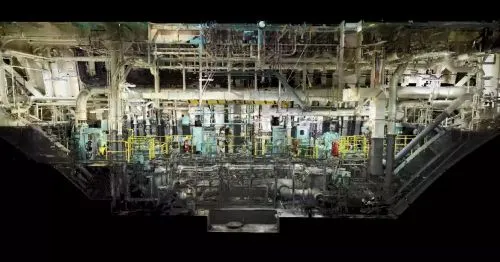
BWTS & EGCS 3d scanning
We provide highly detailed 3D Scanning to capture the “as-built” condition of the vessel and assist in the design and installation of ballast water management system (BWMS) technologies or Scrubber Exhaust Gas Cleaning System(EGCS) conversions. 3D Modeling demonstrates how either of these systems and associated filters and piping, will fit within the available space for the vessel. 3D Laser scanning of vessels with different types(Bulk carrier, LNG tanker, Chemical Tanker, container vessel, VLCC, etc.) and sizes LOA – 70m to 500m large vessels required 3D Scanning for BWTS, EGCS, or hull scanning for restoration/design verification. Fibrox3D has done 50+ vessel 3D Scanning and Surveying(preliminary survey) of the vessel for BWTS & EGCS onboard. The preliminary survey includes mainly, report preparation, collection of documents, photos, videos of the critical piping system of the vessel. How we do complete engineering project for BWTS & EGCS systems installation onboard explains point-wise
- Contract and request for order
- Onboard survey and 3D ScanningSpace
- Feasibility study for maker and reverse design
- Complete Engineering
- Preparation of ISO drawings for fabrication & class approval
- Installation & commissioning
FAQs
It digitally captures the engine room’s exact geometry using laser or structured light, enabling accurate modeling and maintenance planning.
It ensures precise measurements for retrofitting, repair, maintenance, and avoids costly errors in confined spaces.
Yes, scans help identify clashes, misalignments, or obstructed components, improving safety and retrofit efficiency.
Modern scanners capture detailed data within hours, significantly faster than manual measurements.
Absolutely, it reduces physical access to confined or hazardous areas, enhancing safety during inspection.
Yes, they provide precise dimensions for designing modifications, upgrades, or new installations.
High-resolution scanners capture millimeter-level details, ensuring reliable measurements for engineering tasks.
Yes, detailed digital models help schedule maintenance, track components, and reduce downtime.
Absolutely, data can be exported into CAD or BIM software for modeling, simulation, and planning.
Accurate scans reduce rework, material wastage, and time spent on manual measurements, lowering project costs.