
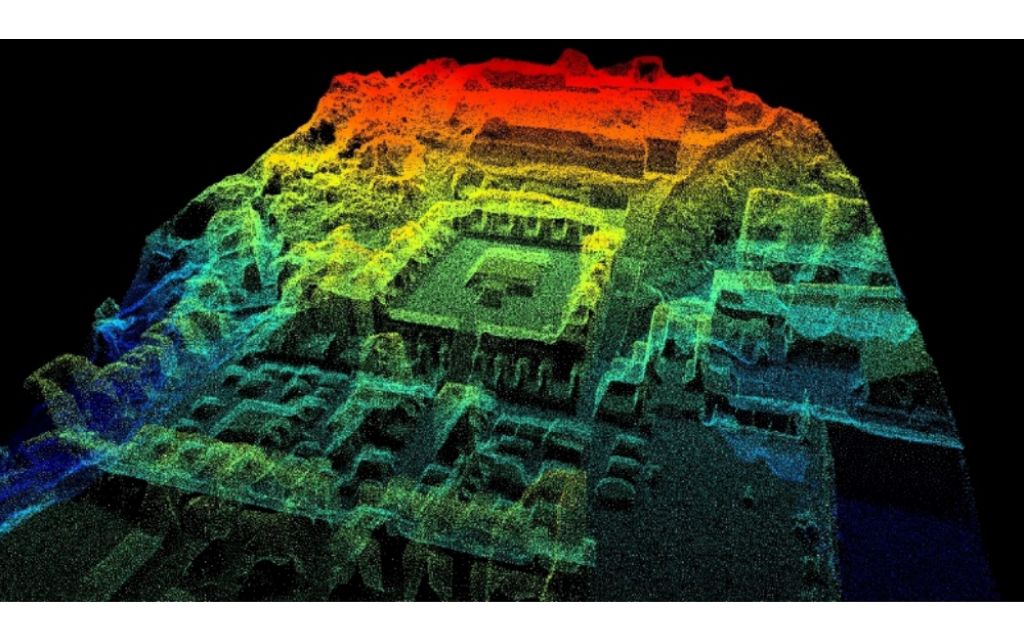
- 1. Scanning: A laser scanner is placed around the site in a manner that will capture all visible surfaces from all available angles. In this manner, the scanner collects millions of data points, hundreds of thousands of times per day.
- 2. Data Processing: The point cloud data is processed using specialized software to create a detailed 3D model of the site.
- 3. Analysis & Archiving: Experts analyze the computer model for structural analysis, restoration planning, or virtual preservation of the original condition. The data will be archived while noting important considerations for future use.
- 4. Restoration or Replication: If any part of the site is damaged, its digital reconstruction could be 3D printed or have original features recreated with existing materials.
- 1. Natural decay: Heritage sites are naturally subject to the effects of time, like aging/exposure, over centuries.
- 2. Tourism: Tourists cause overcrowding and related issues, wear and tear, with between 5000 and 30000 tourists, some wear and tear occurs.
- 3. Urbanization: as cities grow and develop, pollution, constant vibrations, as well as development activity nearby, can have dramatic effects on heritage sites.
- 4. Neglect: Natural disasters may have an enormous impact on heritage sites. Damage and loss can be irreversible in the case of fires, flooding, and earthquakes.
- 5. Disasters: Heritage sites are naturally subject to the effects of time, like aging/exposure, over centuries.
- The site is fragile or structurally unsafe to access
- There is a need to document the condition of a site before restoration
- The museum or VR product needs an accurate, high-fidelity replica
- Weakening of the structure
- Development of new cracks or damage
- Erosion of surfaces
- Be preserved as a cultural archive
- Be a resource for virtual tourism
- Be printed as scaled models for documentation and pedagogical purposes
- 1. Site Survey: Experts visit the site and study the layout.
- 2. Equipment Setup: Scanners are placed at various vantage points.
- 3. Laser Scanning: Data is collected from all visible surfaces.
- 4. Software Modeling: The point cloud is converted into a 3D model.
- 5. Report & Archive: Detailed visuals and measurements are archived.
- 6. Use cases: Used for restoration, virtual tours, or academic research.
- The cost of equipment and software could be prohibitive.
- Local authorities still use outdated approaches to 3D laser scanning technology.
- There are more trained professionals; however, not nearly enough.
- There is a colossal amount of data to manage (terabytes).
- Equipment tested in the field
- Trained teams that specialize in heritage scanning
- Accurate documentation and model rasterization for a digital record
- Post-processes and consultation for restoration
- Reporting for legalities and conservation.
The heritage places are not the old buildings or monuments that are being referred to, but the heritage of history, culture, and sense of a nation. Be it a beautiful temple, a shabby fort, or any other place, they are symbolic representations of our past and the history of our forefathers.
However, over time, weather, pollution, and human practices can devastate these unique resources, and there is a risk of decline at all times. Technology comes in here, and among the most successful techniques of preservation of a historic cultural heritage zone is the application of 3D laser scanning.
This guide will tell you how 3D laser scanning saves heritage sites, the process, its advantages, and how 3D laser scanning services in India are transforming the preservation of buildings of historical significance.
What Is 3D Laser Scanning?
The 3D scanning laser in India is non-contact and non-destructive, and this technology is based on the laser-based scanning technique wherein the size and shape of a particular object can be measured with precision and accuracy, plus the surface details of an object can be measured.
In operation, the scanner creates a high-resolution three-dimensional digital representation, sometimes called a point cloud model, that may later be used in documentation, analysis, planning, restoration, and even virtual experiences.
How 3D Laser Scanning Works?
Why Are Heritage Sites at Risk?
Over half the World’s Heritage Sites have lost most of their original features. In India many heritage sites are particularly vulnerable for several reasons;
Conventional site recording techniques, such as photography and hand measuring of sites, are rather slow and prone to human error. With so many issues in preservation, how 3d laser scanning technology is being used to preserve heritage sites is now a global subject of interest.
Key Benefits: How 3D Laser Scanning Saves Heritage Sites
1. Accurate and Precise Documentation
Laser scanning provides millimeter-level accuracy as it captures even the smallest carvings, engravings, or cracks. This is extremely beneficial when:
2. Non-Invasive and Safe
As a non-contact technology, 3D scanning does not harm the condition of the structure in any way. It does not penetrate, touch, or induce movement – this is perfect for delicate or precarious heritage sites.
3. Supports Restoration and Conservation
Because conservators now have a record of the original scan, they can analyze newer scans over time to note changes like:
This will help establish a precise timeline for a timely restoration and ensure that the most important areas of issues are prioritized.
4. Facilitates Digital Preservation
In the event of the destruction of a site due to calamity, warfare, or accident, a derived digital twin of the heritage site makes certain that the legacy is not lost forever. The site model could:
5. Helps in Legal Protection and Planning
In land disputes, encroachments, and unlawful constructions adjacent to protected monuments, 3D scans provide a digital archive/snapshot to assist authorities in undertaking actions.
Applications of 3D Laser Scanning in Indian Heritage
India has more than 3600 centrally protected monuments along with many thousands of local monuments. And while many of the sites have been recorded, only a small fraction are documented and well-maintained. This is where 3D laser scanning services in India have already been useful:
1. Taj Mahal, Agra
As one of the most famous monuments on earth, the Taj Mahal has been 3D laser scanned to assess stability, on the foundations, and issues with erosion attributed to pollution on its surfaces.
2. Qutub Minar, Delhi
With its height and stone block structure, the manual documentation of Qutub Minar was impossible. However, 3D laser scanning identified the stress points, and any restoration issues to consider going forward.
3. Ajanta and Ellora Caves, Maharashtra
Caves that preserve elaborately carved interiors, dark spaces, and narrow entrances and interiors present problems for traditional mapping.
Digital mapping and suspended video see the primary use of scanning for recreation, without damaging the interiors of the caves.
4. Hampi, Karnataka
It was the site chosen for the 3D laser scanning as a UNESCO World Heritage Site. The ASI noted a full documentation of the site and the planning of the management of the monument site, documenting all surface monuments.
These monuments are being documented, and new uses for 3D laser scanning in the world of academia and historiography in India have grown as the ASI and State Departments of Archeology are deploying their initiatives of digital preservation projects.
How is 3D Scanning Used in Practice?
Here’s a simple walkthrough of how 3D laser scanning saves heritage sites and preserves them using this technology:
Challenges and Future of 3D Scanning in Heritage Conservation
The possibilities are vast, but some areas continue to be a challenge:
But there is great hope for the future. Digital India programs from the government of India, combined with the growing interest and support from the private sector, mean that 3D laser scanning services in India are becoming fairly easy to access and relatively cheap.
Why Choose Professional 3D Laser Scanning Services in India?
Whether you are a heritage management body studying, designing, or preserving India's wealth of culture, an NGO, or a researcher, you need to work with specialists who understand not only the technology but also the complexities in the preservation of sites and spaces that are significant to the culture of India.
Professional 3D laser scanning services in India provide:
Final Thoughts
The protection of heritage is not a matter of clothes and stone; it is a matter of statistics, precision, and perspectives. Knowing how 3D laser scanning saves heritage sites, puts the power in the hands of governments, conservators, and communities, to act before it's too late.
In a world where the only constant is change, and where irreversible loss is just a natural disaster away, 3D laser scanning services in India are quickly establishing themselves as essential. We can apply technology, not just to make sense out of what is about to happen, but to have in our grasp what has happened.
Would you like to maintain your heritage site with the use of state-of-the-art technology? Select an expert professional like Fibrox3D to work with the best 3D laser scanning services in India, and the trusted name that has been using their services in a respectful, efficient, and precise documentation of all heritage sites.
Read More: How Reverse Engineering Services Drive Product Innovation