
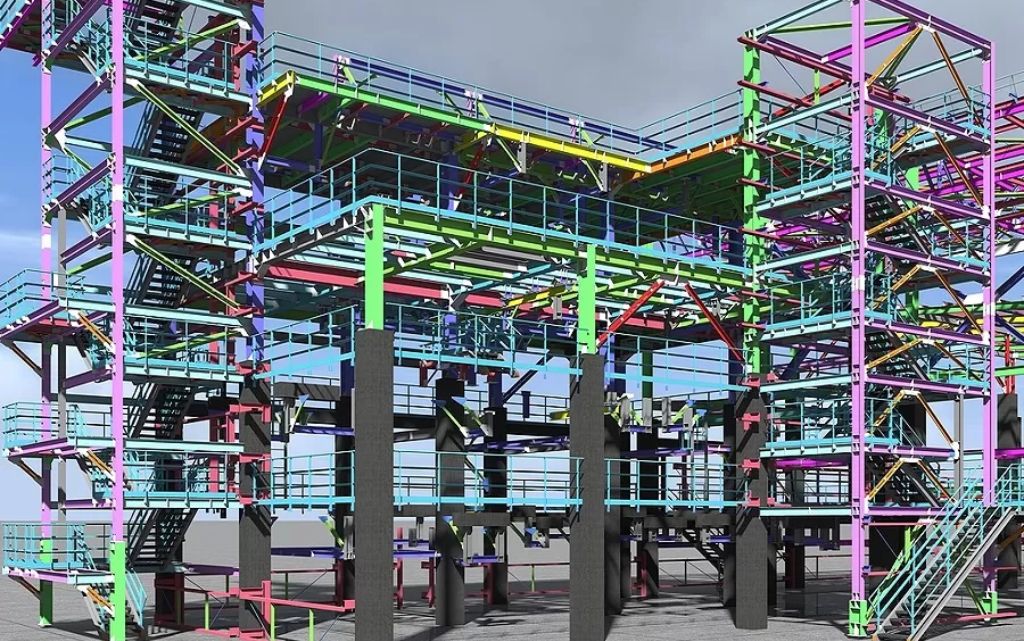
- 3D Laser Scanning or photogrammetry of a building or site
- Processing point cloud data
- BIM elements (walls, floors, MEP systems, etc., modeling)
- Validation and documentation
- Historic Preservation:People can use scans of old places to make correct BIM models for saving, fixing, or showing to the public.
- Facility Management:Big areas or work sites use Scan to BIM ways to keep track of things, watch for repair needs, and plan for better setups.
- Construction Progress Watching:Regular scans when building can be checked against BIM models to see growth, spot errors, and stay on time.
- Renovation & Upgrade Tasks:AI makes it easy to write down current states, aiding teams to model and set plans for upgrades fast with little mess.
- High First Costs:Getting AI tools and gear can be pricey, mainly for small groups.
- Data Trouble:Scan points can be very full and not in order. Making them work well and look good on all devices and places is still hard.
- Need to Learn:Teams must learn how to use AI tools well. There's a call for more skills in the field.
- Need for Good Starting Data:AI needs great scan data. A bad first lidar 3d scanner can mess up the truth of the whole model, even with automation.
Scan to BIM Workflows have been pivotal in the construction and architecture industries for quite some time. Whether it has meant measuring improvements, shortening documentation time frames, or creating an involved and actionable planning process, Scan to BIM continues to provide agents with original, faithful digital twins of grounded physical entities for renovation, preservation, maintenance, or use as an analysis reference point.
However, if there is one aspect of the older processes worth improving, it is the production time. Professionally, traditional Bim Scanning methods have also been time-intensive, error-prone, and require repeated intervention from BIM agents to complete the process.
Let’s break down what is changing with AI (artificial intelligence), automation, and the impact on Scan to BIM workflows. What benefits will this process bring about, and what are the impacts for the future of AEC (architecture, engineering, and construction)?
Understanding Scan to BIM Workflows
To better understand the influence of AI and automation, let's get familiar with what Scan to BIM processes entail. The process usually entails:
Manual modeling from point clouds was previously the most labor-intensive process, involving trained experts to read scan data and interpret it as 3D models. But now automation and AI are speeding these processes considerably.
The Rise of AI in BIM Scanning
AI has come into the world of BIM scanning with strong programs that can spot, sort, and change cloud data into BIM parts very well. Here’s how AI helps:
1. Spotting & Sorting Things
Learning programs are set up to spot parts like walls, doors, and pipes in big cloud data. This cuts out the need for hand marking and makes splitting up scanned data much faster.
For example, an AI setup can find the same items, such as columns in a building scan, and change them into standard BIM items.
2. Cutting Down Noise & Cleaning Data
These clouds can scan and often carry "noise" extra bits from blocks, tools, or people moving. AI can clean and sift out these bits in no time, making sure the data is more suitable for making models.
3. Guessing Models
Top AI setups can now fill in lost scan data with guesswork skills. If parts of a wall or top are not seen during scan, AI can guess and remake them from known ways from other parts of the building or like work.
Automation in Scan to BIM Workflows
While AI is responsible for interpretation and decision making, automation provides the mechanics to carry out repetitive tasks in Scan to BIM workflows.
Let’s uncover some of the major advantages of automation:
1. Automated Geometry Creation
After AI classifies the elements in the scan, automation tools can immediately create parametric BIM components. This dramatically reduces the modeling time for projects that previously took weeks to model.
2. Automated Clash Detection
The use of automation can ensure that the design conflict between the architectural, the structural, and the MEP system is discovered early enough in the digital model. This is useful to those of the renovation or retrofit projects, as original conditions need to be taken into consideration and are to be known completely.
3. Full compatibility with BIM Software
Automation has enabled better integration to take place between BIM scanning tools (i.e., Leica, Faro, or Trimble scanners) and modeling programs such as Autodesk Revit. In eliminating the manual transfer of data, it further reduces the chance of errors.
Benefits of AI & Automation in Scan to BIM Workflows
The confluence of AI and automation provides AEC professionals the following advantages:
1. Speed and Efficiency
With traditional workflows, surveying, modeling, and documentation for a large project would take hundreds of hours. However, when AI and automation are used, the time for modeling is reduced by up to 70% because AEC professionals can output projects in a short period.
2. Cost Savings
It saves most of the operation costs by automating 80 per cent of the manual work. This provides teams with the capacity to work on elevated decision-making, rather than devoting their forces to redundant duties.
3. Increased Accuracy
AI reduces human error, and with AI being able to recognize adjacent elements, it allows increased precision while producing a model. This plays an important role in preserving the integrity of renovations, historical buildings, etc.
4. Scaling
Firms can now utilize what was formerly a linear process of modelling workflows and have the capability of realizing multiple Scan to BIM workflows concurrently. Without overwhelming manpower, AI allows small teams to tackle large-scale modelling processes more efficiently.
5. Data-Driven Decisions
As they generate building Information models from the scan data, project stakeholders may now make informed decisions using actual conditions of the existing hospital or suite, eradicating decision-making risk and facilitating information sharing between users in real time.
Use Cases and Real-World Applications
AI tools in BIM scans are now used in many work fields:
Challenges in Adopting AI and Automation
But using AI and automation in Scan to BIM isn't easy:
The Future of Scan to BIM Workflows
As new developments occur in the ever-growing AI-automation space, expect further advancements to Scan to BIM workflows:
Cloud-Based Collaboration
Cloud platforms are starting to merge with Scan to BIM workflows, allowing teams to work together on developing BIM models in real-time, regardless of where they are in the world.
Generative Design
AI won't just assist in documenting existing structures - it will also assist in the design of the structure itself. In generative design, the algorithms use AI to provide idealized layouts and structures using scanned structured data.
AI Feedback Loops
Unlike previously created AI systems, the next generation of AI will continue to improve through learning. The more projects they complete, the faster and more reliably they will become.
Augmented Reality (AR) Integration
When appropriate BIM models are developed from scans, AR devices can superimpose the models being developed onto the current state of the structure, whether for on-site verification/maintenance, or as a part of the construction tasks in completing the project.
Conclusion
AI and automation are revolutionizing Scan to BIM workflows by making them faster, smarter, and more accessible. Architects, engineers, and contractors are getting improved results at reduced man-hours by reducing their manual work and improving model accuracy due to AI and automation.
These tools are also expected to be indispensable tools in any construction and renovation work as they improve. To embrace AI-based BIM scanning today is to prepare for a future where digitization, speed, and smart data reign supreme in the built environment.
Read More: What is plant 3d scanning?