
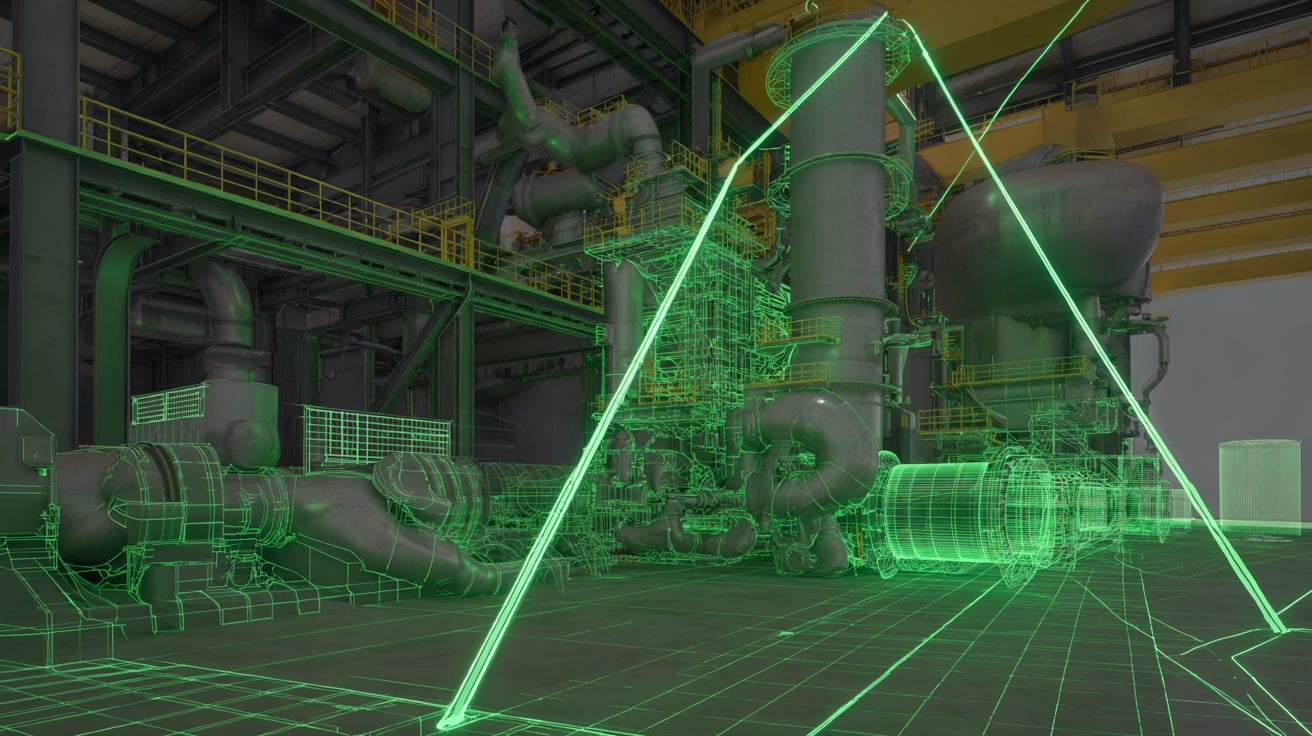
- 1. Refinery and Petrochemical Plants:To map complex piping systems and in support of maintenance schedules therefore reducing inspection time and improving design accuracy for retrofitting.
- 2. Pharmaceutical Plants:Because clean rooms are highly optimized with little space or elbow room for traditional surveying plant 3D scanning allows for redesigns without halting production.
- 3. Power Plants:Thermal, hydro, and nuclear - maintaining efficiency and compliance of these expansive facilities is simple with accurate 3D models.
- 4. Food & Beverage Plants:With the ability to manage hygiene standards, layout improvements, and expansion ,ans - all with minimal production downime, and disruption.
- 5. Automotive and Aerospace Manufacturing Units:Ideal for design planning, space optimization, and identifying misalignments in assembly lines.
- Initial Setup Cost:Investment in equipment and software can be considerable.
- Data Management:Point clouds are big files and need to ron in high-performance computing.
- Skilled Professionals:Specialized training is required for scan interpretation and 3D modeling.
- IoT sensors
- Artificial Intelligence predictive maintenance
- Real-time monitoring augmented reality (AR)
In a rapidly changing world of industrial design and engineering, Plant 3D Scanning is dramatically changing the mapping, monitoring, and modification of factories, refineries, and power plants. However, many people continue to ask—what is plant 3D scanning, and why is it essential in the industrial sector?
In this blog, we will answer these questions and more by exploring the concept, technology, use cases, and values of plant 3D scanning, so that industries will have the awareness of why plant 3D scanning is the future of intelligent plant design and maintenance.
Understanding the Basics: What is Plant 3D Scanning?
Plant 3D scanning is best explained as the use of highly technical laser scanning technology to capture, in space-accurate, real-time, 3D data, everything in an industrial setting, including piping systems, machines, structural elements, and everything else that is included in a plant or factory environment.
So the next time someone asks, "What is plant 3d scanning?", what they are asking is how modern engineering teams can most efficiently digitally replicate the complexities of an industrial environment. They are laser scanners that can be mounted on tripods, or drones, that create point clouds of millions of points of laser data, every second, and build 3D models.
The point clouds are then converted into smart 3D models through CAD or BIM software in order for subject matter experts to look at them to plan maintenance, retrofits and expansions to the accuracy of a pinpoint.
How Does Plant 3D Scanning Work?
The plant 3D scanning process typically includes these main steps:
1. Pre-Scanning Preparation
The scanning team evaluates the surroundings, establishes scan targets (equipment, piping, etc.), and develops a scan plan for thorough coverage.
2. Laser Scanning
With LiDAR-based laser scanners, millions of data points are recorded from many angles. These scanners will record all the details, from wall alignments to pipe joint curvatures.
3. Data Registration and Processing
The scan data collected at several stations is then registered and merged by computer software. This builds a single, cohesive "point cloud" of the entire facility.
4. 3D Modeling and Analysis
Engineers and designers take the point cloud and create 3D CAD or BIM Models that can be used for additional engineering, design changes, clash detection, or optimization of a plant.
The Role of Plant 3D Scanning in Modern Industry
Engineering and construction are in a full-speed boom into the 21 st century where speed, accuracy and data-getting decisions has occupied the centre stage of significance. And this is where plant 3D laser scanning technology becomes so crucial.
Traditional manual surveying methods usually disrupt operations and thus are impossible to maintain during operational hours in life facilities due to which they are discarded by almost all plant 3D scanners to maintain operations.
The industry is relying more and more on this technology to reduce errors and improve workflow, from planning new installations to ensuring their compliance with safety standards.
Whether you are designing a plant from scratch or upgrading an old one, plant 3D scanning shall be the source of real intelligence and selecting experienced services is vital. Check Fibrox3D services for more information.
Why is Plant 3D Scanning Important?
In industries where downtime is costly and safety is prioritized, plant 3D scanning presents numerous benefits:
1. Accuracy and Detail:
Traditional measurements can be subject to human considerations, but plant 3D scanning will measure a physical space to the millimeter level to ensure dimensions are not overlooked.
2. Time-Saving:
Scanning a large plant can take hours instead of days. Furthermore, in most cases, shutting down plant and machinery is not required, limiting disruption.
3. Safe Data Collection:
Scanners remotely capture hazardous and hard-to-reach environments thus improving workplace safety.
4. Cost-Efficiency:
Less manual labor, less rework, and planning can be expertly optimized therefore saving costs in the long run.
Applications of Plant 3D Scanning in Industry
If you are wondering how this technology can be beneficial to ,you here are real-world examples of plant 3D scanning across industries:
Challenges in Plant 3D Scanning
While the advantages are limitless, sectors also need to be cognizant of some challenges:
All these notwithstanding, the ROI on plant 3D scanning warrants the investment for long-term productivity and safety benefits.
The Future of Plant 3D Scanning
Plant 3D scanning will be an integral part of smart factories as industries transform towards Industry 4.0 and digital twins. It's already being combined with:
These improvements can give companies the ability to see plant performance and energy savings with no involvement or with as little involvement as possible.
FAQs
Q1: What is plant 3D scanning and how is it different than a 3D scan of something?
Plant 3D scanning is a type of 3D scan that is used in a certain way, within an industrial facility. It is different in scale, complexity and for its application within piping, machinery and structural modeling.
Q2: Why is 3D scanning important in a retrofit project?
Retrofits require precise spatial data for certain equipment. Plant 3D scanning provides precise measurements and allows engineers to fit equipment and not damaging existing structures.
Q3: How long should a typical plant 3D scanning project take?
Time varies depending upon the size and complexity of the plant, but typically a mid-sized facility can be completed in 1-3 days, with another few days to finish the modeling.
Q4: Can 3D scanning be done in operating plants?
Yes! The major benefit of performing the plant 3D scanning is that it does not require shutdown of the plant thus eliminating all costly shutdowns.
Conclusion
The definitions of what is plant 3D scanning are very important to know by industries, which wish to make its operations faster, and safer, yet precise. This technology can be used to do realistic digital modelling of the complex industrial surroundings facilitating superior planning and maintenance and more superior upgrading.
Minimizing downtime to increasing the precision of design, plant 3D scanning has become a mandatory step in the process of smart factory transformation and the implementation of Industry 4.0.
At Fibrox3D we provide an innovative plant 3D scanning service to provide actionable information that is accurate like never before. Our professional services guarantee success of your retrofit projects in old systems or construction of new systems with minimum costs.
Enter the world of accuracy-go to Fibrox3D to find out more about our plant modeling and scanning services.
Read More: How Scan to BIM Benefits Improve Accuracy in Building Design