
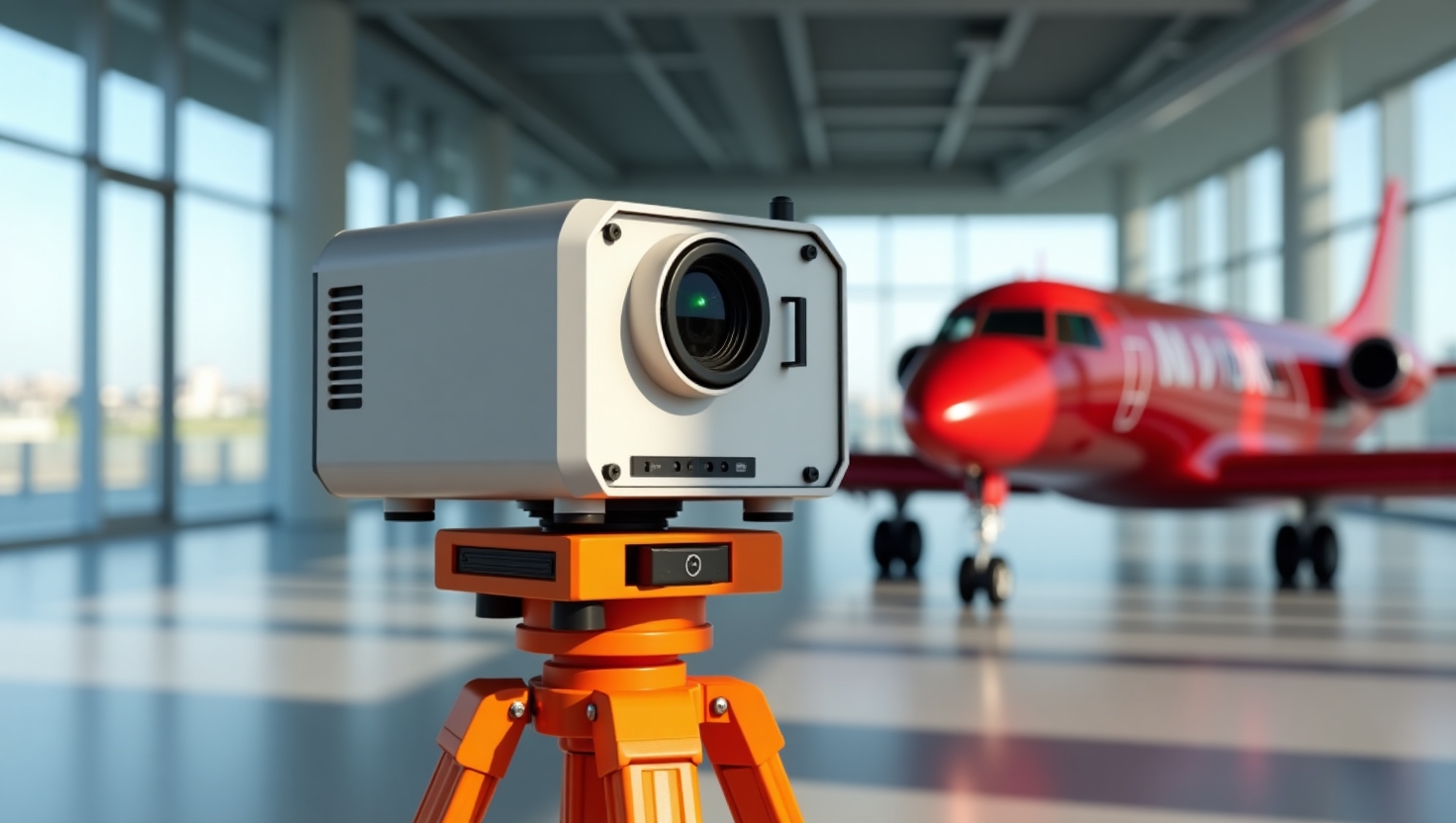
- Scanning Setup: The scanner is calibrated and set up to either cover full coverage or multiple angle coverage.
- Data Capture: Structured light, or laser, scans the surface to capture the millions of points (or point cloud) in 3D.
- Registration & Stitching: If there is more than one scan, then they must be registered or aligned, and then stitched or combined together into a complete dataset.
- Mesh Generation: The point cloud is transformed into a surface model or mesh.
- Post Processing: If required, the mesh can be cleaned or edited, or exported to CAD or BIM software.
- Terrestrial Laser Scanners: It is best applicable in the surveying of structures, terrains, or factories. A terrestrial scanner can be mounted on a tripod and can scan quite long distances (hundreds of meters).
- Structured Light Scanners: Also confined to the larger surface for capturing detail, but with short distances (but greater distances than terrestrial).
- Photogrammetry: Not necessarily a scanner, but high-resolution photographs and computer software algorithms take the images to perform 3D reconstruction modelling at a larger scale. (Photogrammetry is often used in construction and cultural heritage).
- Mobile 3D Scanners: It is a scanner that can be mounted on a vehicle, drone, or other movable platform that allows the scanner to have access to the data over a longer distance. This is a great scanner to survey or collect data for any large survey or road/rail infrastructure.
- High Precision and Detail: Contemporary scanners capture detail at every scale to nearly millimeter accuracy, which is essential for quality control and engineering.
- Time Saving and Cost Effective: Manual measurements can be quite time-intensive, and the accuracy of large object measurements can be very difficult to control when relying solely on physical measurements.
- In fact, in many instances, 3D scanning can reduce survey time by 50 - 70% on large measurements.
- Digital Record: Large-scale projects such as renovation of architectural heritage or new build ships might benefit from having a digital twin of every project: a full, usable file that can be stored, shared, or used again when needed.
- Easy Export or Integration to CAD/BIM Systems: Scanners can produce files that are ready to import into the well-known and common design and construction programs, which is a beneficial practice for workflow in a design engineering atmosphere, architecture, or product design.
- Security: Scanning eliminates the requirement of physically accessing what may be dangerous locations or physically inaccessible objects (such as they are inside a chemical factory or on high structures).
- Develop as-builts of the as-built sites.
- Know that what has been constructed is what was designed.
- Have a blueprint for renovations/expansions with no uncertainty.
- Reverse engineer legacy machines that exist.
- Inspect really large components, ie, turbines, gearboxes.
- Asset documentation and management for maintenance and planning.
- Scan the entire vehicle and aircraft fuselage, aircraft undercarriage.
- Find out the condition of the wear, tear, deformation, or damage due to impact or collision.
- Improvement of prototyping and fitment testing.
- Digitally Archive Monuments, Statues, and the Excavation.
- Rebuild heritage structures with missing/damaged parts.
- Conduct research and training remotely by using 3D models.
- Create high-resolution terrain maps.
- Plan road and drain locations and the cities' needed infrastructure.
- Integrate into municipal (GIS) systems and models.
- Line of Sight: Utilizing a scanner to scan a large or complex object usually requires careful planning and an understanding of multiple angles to satisfy the requirement of the scanner "seeing" all of the surface area.
- Data Management: Scans of large-scale objects will produce very large datasets, sometimes on the order of hundreds of gigabytes, and will require the use of stronger hardware and data management skills for processing.
- Environmental conditions: Dust, bright sun, and reflective materials can all affect scan quality, so it is easier to maintain conditions when inside, where it can be controlled.
- Equipment costs: Most high-end large scanner services rely on the use of expensive hardware design and implementation. These costs are reflected in the project costs for the service of the scanner. The reduction in rework in the intangibility of true return on investment may offset the initial costs.
As we continue to witness a transformation of industries through precision, speed, and digital duplication, Large-Format 3D Scanning, or 3D laser scanning for large amounts of data, has quickly risen to be a revolutionary technology.
Large-Format 3D Scanning is applicable in many areas, from aerospace engineering to automotive manufacturing, from conserving heritage to building large structures. 3D scanning at a large scale is here and is not simply a future consideration, but has become a modern necessity.
Whether you are a new user in the 3D scanning industry, or you're simply looking to ramp up your processes, this article will delve into Large-Format 3D Scanning and how it works, along with insights from the capabilities, benefits, applications, and how Large Scanner Services can allow industries to run at an unprecedented speed and detail.
What is Large‑Format 3D Scanning?
Large-Format 3D Scanning refers to the ability to digitally record the geometry of large objects or environments, where the physical capture is completed using high-precision Laser Mapping scanners or structured light scanners.
These scanners are not intended for traditional 3D scanning, where you would scan handheld objects or small parts, as large-format scanners are developed and engineered to work with whole vehicles or machines, buildings, and landscapes.
Of significance, these scanners allow the creation of detailed 3D objects, or "digital twins," that can be used for whatever is necessary, such as reverse engineering, inspection, validation of designs, and for opportunities to explore in virtual reality.
How Does Large‑Format 3D Scanning Work?
The Large-Format 3D Scanning works under the premise that a laser, or light pattern, is projected over a large object, while high-resolution cameras capture the deformation of the patterns. The main steps usually include:
Types of Large‑Format 3D Scanners
Various types of scanners can be used for large scanning services, depending on the intended project´s goal:
Benefits of Large‑Format 3D Scanning
There are many advantages to using large-scale scanner services:
Applications of Large‑Format 3D Scanning
There are a variety of industries using Large-Format 3D Scanning technology. These are some examples of the various industries:
1. Manufacturing & Industrial Plants
2. Manufacturing & Industrial Plants
3. Automotive and Aerospace
4. Cultural Heritage and Archaeology
5. Urban Planning and Surveying
Choosing the Right Large Scanner Services
In choosing a big-scale scanning service provider, I would like to bring the following points to your attention:
1. Equipment and technology
Choose a service provider that provides newer, modern scanners that will capture the amount of detail necessary for your project.
2. Accuracy and resolution
Check the service providers' project experience and expertise. Some large scanning applications ask for +/- 1 mm accuracy and while other applications and areas can be +/- 5-10 mm.
3. Deliverables and compatibility
Formalize the deliverables (point cloud, mesh, or CAD files) you will receive are compatible with the software you wish to use = Revit, Autocad, Solidworks, etc.
4. Industry experience
Choosing a vendor with industry experience will aid in their understanding of your project needs and compliance.
5. Post-Processing
Scanning is only half the work; you should inquire if the vendor will provide either mesh clean-up, CAD modelling, or BIM modelling.
Challenges in Large‑Format 3D Scanning
While 3D scanning at a larger scale is a formidable technology, there are a few challenges to consider:
The Future of Large‑Format 3D Scanning
With digital twins, smart factories, and Industry 4.0 becoming mainstream, Large-Format 3D Scanning is rapidly advancing with applications including AI and automations for real-time defect detection and automated CAD modeling, and the use of drones and mobile scanning is enabling speed and accessibility.
Application of large-format scanners is becoming commonplace, with the industries expanding and companies, large and small, and startups leveraging large scanner services to improve quality, accuracy, and productivity.
Conclusion
The Unprecedented scale and reach of Large‑Format 3D Scanning are transforming how we capture, design, and engage with physical buildings and objects. The construction of skyscrapers, the correction of a historic monument, or even the manufacturing of large industrial components needs exactness, performance, and numbers inside the digital world to be sufficiently ahead of the competition. Large scanner services offer the energy, the precision, and digital knowledge to remain one step ahead.
Fibrox3D's large scanner services will provide precision and clarity to every corner of your project with on-site and digital twins that capture an aircraft, industrial plant, or heritage building.
We specialize in turning large and complicated structures into accurate 3D models that drive your designs, inspections, and renovations.
Read More: Drone Surveying for Real Estate in India: Accuracy, Insights & Savings