
- Outsource effectively:You can also outsource scanning and modeling services to third-party service providers without necessarily investing in the equipment.
- Avoid going large-scale:Invest in pilot projects to prove ROI before going about starting larger projects.
- Take advantage of government benefits:A lot of areas offer digital construction projects nowadays with grants and subsidies.
- Scale-huge storage and real-time sharing by means of cloud-based solutions.
- Adopt standard rule protocols of file names and metadata to prevent confusion.
- Use effective applications such as Autodesk ReCap or Navisworks, which are point cloud processing applications.
- Break projects into manageable areas as opposed to extensive structures in one process.
- Set standards of quality:Before scanning, analysts are expected to define standards of accuracy.
- Carry out checking in relation to checking tests: Regularly, check scan data against measurements at the location.
- Employ seasoned operators:Experienced people reduce the number of mistakes and provide quality outcomes.
- Provide in-house training and certifications as a way of upskilling current employees.
- Outsource complicated projects in which precision is important.
- Collaborate with vendors of technologies, with many of them offering practical workshops and technical assistance.
- Take industry compatible formats:File formats such as .E57 and .RCP are compatible.
- Use open BIM standards:The use of IFC-based workflow will facilitate cross-platform collaboration.
- Select integrated ecosystems: Software such as Autodesk and Bentley offer end-to-end workflows, which minimize the problem of interoperability.
- Present case studies of cost saving and efficiency increment.
- To show real gain, carry out pilot projects.
- Encourage the culture of innovation and flexibility at the company.
- Prepare detailed budgets on hardware, software, labor, and training.
- Use less scanning and more priority on the scanning of key areas instead of over-modeling the details.
- Reduce recurrent expenses by using software on a subscription basis and shared cloud solutions.
- Keep track of the schedule of the projects and reallocate resources.
- Utilize specialist equipment, including mobile LiDAR or drone scanning.
- Be guided by people who have worked on a heritage or an industrial project.
- Advanced modeling software, which can deal with irregular geometries, should be used.
- Scanning plans should be laid out in detail before execution in a bid to prevent omissions.
- Using a secure cloud entails encryption and compliance qualifications.
- Role-based access restrictions.
- Conduct routine disaster recovery and backup processes.
- This should be supported by the promotion of lifelong learning via training and workshops.
- Largely replace equipment and software to enhance efficiency.
- Consult technology suppliers to get an idea of best practice.
- Nurture a culture of flexibility to adopt innovation fast.
Scan to BIM implementation has brought a colossal change in the architecture, engineering, and construction (AEC) industry. The ability to acquire real-world conditions and translate them into intelligent 3D models with the help of laser scanning provides the project teams with highly accurate and data-rich information that will enhance project planning, design, and execution.
Nevertheless, even though BIM scanning is becoming increasingly popular, organizations usually have difficulties when adopting it. Over technical obstacles, lack of skills, or economic considerations, adoption of Scan to BIM needs a strategic approach.
This blog discusses the most widespread challenges in Scan to BIM implementation and gives real-life solutions to these problems to make sure that you get maximum benefits of this powerful technology in your projects.
What is Scan to BIM Implementation?
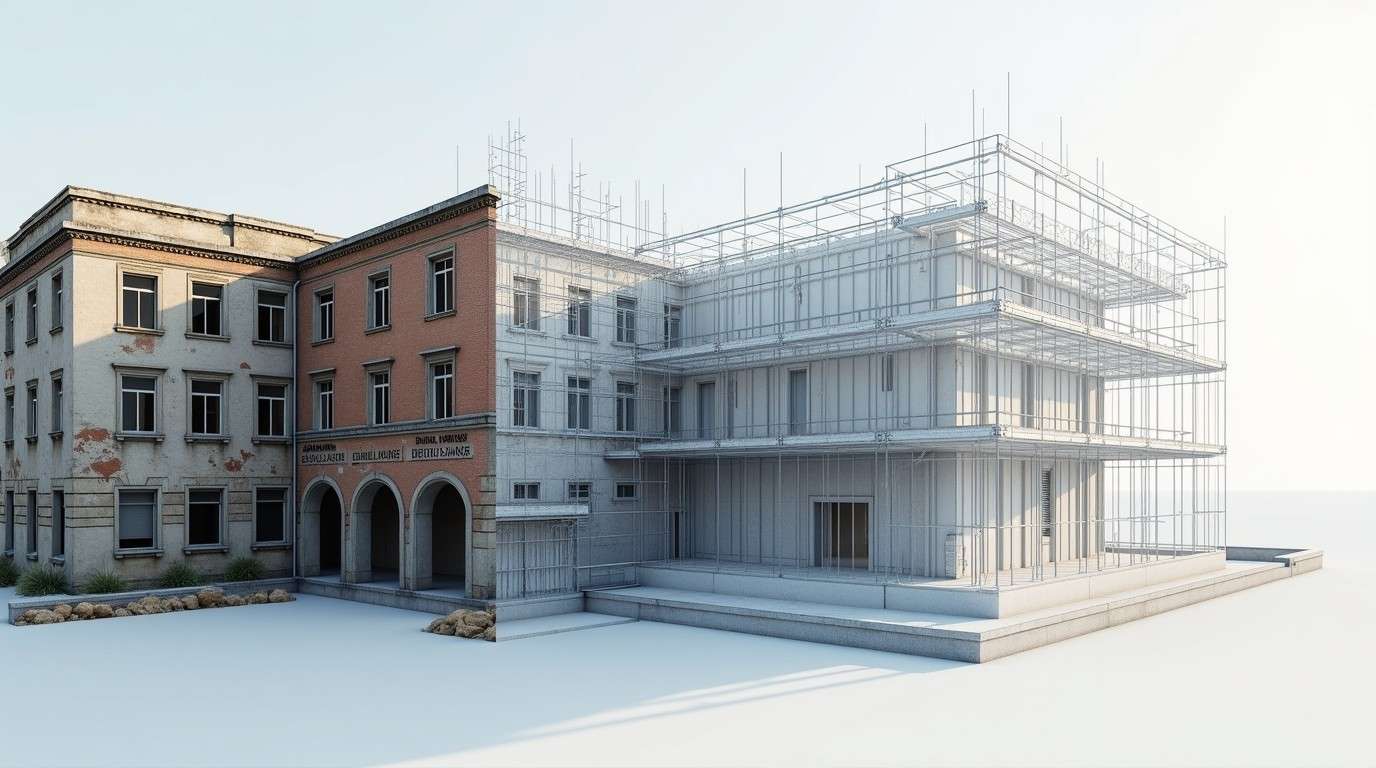
Scan to BIM implementation is an operation of scanning the real-world structure, sites, or environment with the help of laser scanning equipment and transforming it into Building Information Models (BIM). The outcome is a very detailed digital twin that forms a solid base for renovation, retrofitting, building, or managing the facility.
This process not only removes guesswork but also rework, and it also improves cooperation. However, there are barriers on the way between rough scan data and the useful BIM models. Let us deconstruct the major difficulties and solutions.
1. High Initial Investment
Challenge:
Implementation of BIM scanning technologies is associated with high initial expenses. 3D laser scanners, point cloud processing programs, and trained specialists are expensive. This may serve as a barrier to entry, especially in smaller firms or organizations that have limited budgets.
Solution
This is because companies that embark on small projects and increase them over time can minimize the financial risks and still enjoy the fruits of Scan to BIM implementation.
2. Managing Complex Point Cloud Data
Challenge:
Massive amounts of data, Terabytes of data, are produced by laser scanning. Companies should have the right infrastructure in place or risk being overloaded by teams that will slow down the collaboration efforts and raise the costs of storage.
Solution
Effective data management will make scan data an asset and not a bottleneck.
3. Accuracy and Quality Control
Challenge:
The precision of BIM scanning is based on such factors as scanner calibration, site conditions, and modeling procedures. Scanning or processing mistakes may cause inaccurate BIM models, thereby causing expensive design or construction errors.
Solution
Good quality assurance measures ensure the avoidance of inaccuracies and improve confidence in the information.
4. Skill Gaps and Training Needs
Challenge:
Despite the increased demand, professionals who are skilled in laser scanning and BIM models are few. A large number of organizations are faced with the challenge of locating talent that is able to fill the gaps in these areas.
Solution
The reduction of the skill gap will facilitate the process of adoption and will lead to a decrease in reliance on external providers over the long term.
5. Interoperability Across Platforms
Challenge:
Interoperability of various software platforms can be considered one of the pitfalls in other Scan to BIM implementations. Point clouds do not necessarily fit well with BIM software, which delays and brings extra expenses.
Solution
Streamlined interoperability guarantees improved interaction among the architects, engineers, and contractors.
6. Resistance to Change
Challenge:
The introduction of new technology is usually met with resistance on the side of the team that was used to the conventional ways of doing things. The stakeholders might feel that the Scan to BIM implementation is complicated, uncertain, or disruptive.
Solution
Effective communication and a track record of achievements make teams comfortable to accept change.
7. Managing Costs and Timelines
Challenge:
Costs may run out of control even once initial adoption has been made when scanning or modeling is ill-timed. Projects are also threatened by time delays.
Solution
Effective communication and a track record of achievements make teams comfortable to accept change.
8. Complex Structures and Irregular Geometries
Challenge:
The irregular geometries, old buildings, and industrial plants are scanned with special challenges. The complicated specifications and inaccessible places need sophisticated strategies.
Solution
The most difficult structures could be photographed with the tools and the knowledge that are necessary.
9. Data Security Concerns
Challenge:
The scans can be used to get confidential data such as building plans and construction designs. In the absence of solid security, this data can be open to data breaches or data intrusion.
Solution
Upon impactful cybersecurity, intellectual property is not only safeguarded, but clients are also assured.
10. Staying Pace with Technological Change
Challenge:
The BIM scanning environment is highly dynamic, and new hardware, software, and workflows are introduced regularly. Organizations that are not up to date are likely to become obsolete.
Solution
Being technologically agile guarantees long-term competitiveness and long-term project success.
Conclusion
Although Scan to BIM implementation comes with many challenges, the problems can be easily addressed using the appropriate strategies. Organizational inefficiencies, such as cost, interoperability, accuracy, and skill gaps, can be addressed to realize the full potential of BIM scanning.
These challenges can be managed proactively by using such solutions as smart budgeting, workflow in the clouds, staff upskilling, and interoperability to see the full potential of BIM scanning.
Finally, the companies that will come out of these obstacles are the ones that will be in a position to provide more intelligent, quicker, and greener projects in the current digital construction world.
Read More: Unlocking the Power of 3D Scanning: How It Works and Its Applications