
- Manual measurements can be variable or incorrect, particularly for complicated buildings.
- Laser scanners collect millions of points, providing accuracy to the millimeter when doing BIM scanning.
- Less Rework:Fewer mistakes lead to fewer changes after construction has begun.
- Less Materials:Less duplication leads to a reduction in materials and labor expenses.
- Preventative Maintenance:Accurate models facilitate understanding of conditions for future scheduled maintenance, which will minimize casualties from out-of-service equipment.
- High-resolution data can now be captured in some cases in a matter of minutes with the latest 3d scanner india and processing capacities, and in challenging settings like industrial sites or tight basements.
- In addition, software applications with AI can now do much of the point cloud to BIM conversion automatically, saving time and achieving higher precision.
- Data Volume:Scanning generates big files that need high computational power.
- Learning Curve:Scanners and BIM software need to be learned by teams.
- Data Interpretation:Breaking down complex point clouds into a useful BIM model requires experienced professionals.
In the fast-moving world of construction and architecture today, accuracy is no longer a luxury—it is a necessity. One of the most innovative technologies leading to high accuracy in this space is BIM scanning.
Also known as Scan to BIM, this new technology uses laser scanners to gather current real-world conditions and convert them to a digital 3D model. This digitizing of the original conditions allows architects, engineers, and constructors to make decisions about their design.
But what are the Scan to BIM benefits, and how do these benefits aid in delivering precision in building design? Let's dig deeper into this technology that is changing the game!
What is BIM Scanning or Scan to BIM?
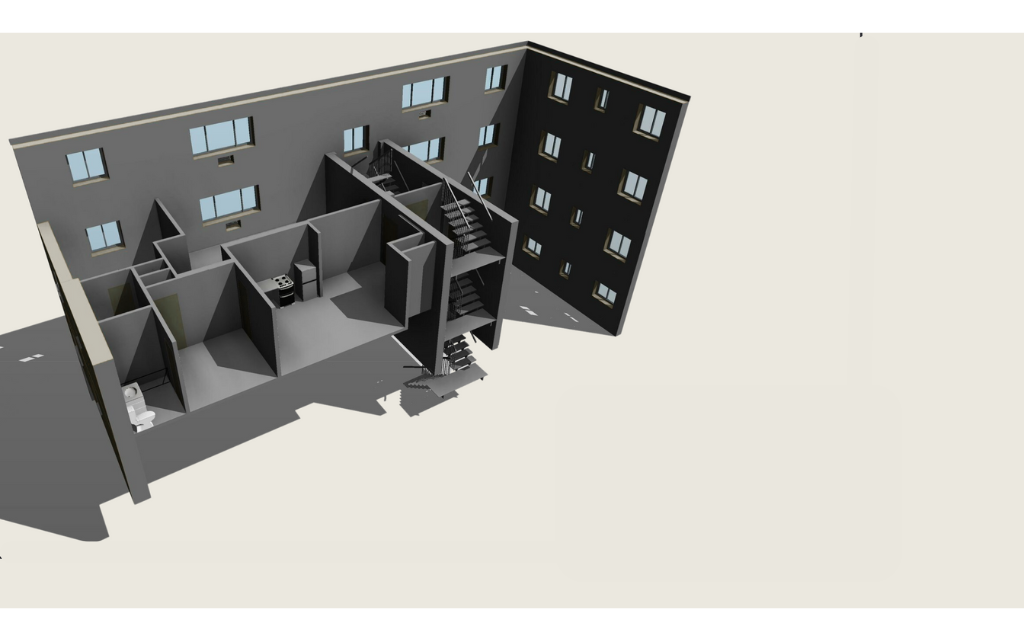
BIM scanning is the process of using a (3D) laser scanner, or LiDAR, to create point cloud data from an existing physical space or object. The point cloud data is then imported into Building Information Modeling (BIM) software, like Revit or AutoCAD, to build an extremely detailed and accurate digital representation of the building.
These models will contain not only the architectural objects but also structural and mechanical, electrical, and plumbing (MEP) objects together, encompassed as a complete, data-rich information model of the built environment.
We at Fibrox3D are experts in innovative BIM scanning solutions that transform physical spaces into precise digital models, enabling you to design, plan, and construct with absolute confidence.
Key Scan to BIM Benefits for Building Design Accuracy
1. Improved As-Built Accuracy
One of the key Scan to BIM advantages is the development of extremely precise "as-built" models.
This creates a perfect replica of the actual environment, something necessary when retrofitting, renovating, or adding on to an existing building.
2. Error Reduction in Design Planning
Design errors often occur because of bad measurements, missing information, and assumptions concerning existing structures.
When utilizing a BIM scan, it is possible to eliminate those unknowns early in the project life cycle; the result will be fewer surprises in construction, waiving the risks of rework, fewer change orders, and that will save time and money.
3. Enhanced Coordination Across Teams
Accurate BIM models created with scan data allow for better coordination between the different disciplines; architects, engineers, and contractors can coordinate. Everybody works from a central source of truth, removes the potential for conflicts, and everyone is working towards the same goal.
Coordination is particularly important for large-scale or complex projects where even a design clash between systems (MEP vs structural, and so on) can result in schedule delays and increased costs.
4. Accelerated Design and Construction Timelines
In the AEC industry specifically, speed is one of the biggest benefits. Scan to BIM is quicker since the designers are given usable 3D models of existing structures (without manually recreating them in the design process).
This allows for the design phase to be expedited, and in turn, early construction starts and faster turnover rates - one of the less talked about Scan to BIM benefits.
5. Reliable Clash Detection
With BIM scanning, designers can simulate how systems will interact with each other spatially. Hence, advanced clash detection assists in spotting possible clashes in architectural, structural, or MEP elements before any field work is undertaken.
Whether it's a restoration of a heritage site, installing MEP systems, or handling a huge commercial project, Scan to BIM solutions are what Fibrox3D offers for projects that demand utmost accuracy and efficiency.
Real-World Applications of BIM Scanning
1. Renovations and Retrofitting
Older buildings tend to have no blueprints or do not have up-to-date ones; in many cases, even undocumented changes may have been carried out. Scan to BIM becomes a real necessity in such cases for making accurate base models for designing modern updates, whilst respecting existing conditions.
2. Heritage and Historical Preservation
Historical buildings do require a sensitive intervention; BIM scanning allows architects to preserve the authenticity of those buildings while implementing the necessary upgrade,s accurate intervention combined with care!
3. MEP System Integration
Appropriate placement of MEP systems in confined or complex building spaces is essential.
Scan to BIM is the spatial clarity that allows engineers to ensure that the systems will fit within architectural confines and performance requirements, and safety codes.
4. Facility Management and Maintenance
BIM models provide a lot of information that will allow owners and facility managers to make informed decisions about maintenance, reno, and energy consumption.
From the lifespan of the building itself, the BIM scan models will remain a valuable source of information for owners and facility managers long after the construction project has been completed.
How Scan to BIM Benefits Drive Cost-Efficiency?
Accuracy is not only about being "right" from a technical standpoint, but it also has a financial impact.
Investing in BIM scanning services in the early stages of the project life cycle may seem costly in thbeginningig,, but will contribute to long-term savings and improved quality and project outcomes.
Technological Advancements in BIM Scanning
The growing uptake of 3D laser scanners, drones, and mobile mapping systems makes Scan to BIM more obtainable and less costly than ever before.
All these advancements are rendering Scan to BIM benefits even stronger and more universal.
Challenges to Consider
Scan to BIM is revolutionary, but it also has its challenges:
But with proper training, equipment, and collaboration, these obstacles are surmountable—and worth the investment considering the return on investment.
The Future of Building Design with BIM Scanning
BIM scanning will play an important role in the evolution of smart, sustainable, and efficient buildings as digitization gradually takes over in construction and design. Green retrofits and smart cities will be better planned, decided upon, and developed with resilience when there is the ability to model environments with a high degree of accuracy.
Conclusion
The use of BIM scanning in the design and construction process will truly be a major leap towards more accurately built, cost-effective, and sustainable buildings. The merits of Scan to BIM thus encompass minimizing error, enhancing collaboration, and accelerating design.
In case the project does not require high accuracy, efficiency, and coordination, then Scan to BIM remains an option. Otherwise, let laser scanning and intelligent modeling know how to create your vision with utmost precision.
Are you ready to receive the full benefits of Scan to BIM in your next project? Fibrox3D provides the most advanced type of BIM scanning using the latest technology alongside proficient insight.